

What structural advantages do large-diameter high-pressure hoses offer?
Release date:
2022-09-09
Author:
Large-diameter high-pressure hoses are a type of hose, distinguished primarily by their large diameter. They are suitable for conveying hydraulic fluids such as alcohol, hydraulic oil, fuel, lubricating oil, water, emulsions, and hydrocarbons. So, what structural advantages do large-diameter high-pressure hoses offer?
What are the structural advantages of large-diameter high-pressure hoses?
Large-diameter high-pressure hoses are a type of hose, primarily because… Large-diameter high-pressure hose It has a large diameter. Large‑bore high‑pressure hoses are suitable for conveying hydraulic fluids such as alcohol, hydraulic oil, fuel, lubricating oil, water, emulsifiers, and hydrocarbons. So what structural advantages do large‑bore high‑pressure hoses offer?
What are the structural advantages of large-diameter high-pressure hoses?
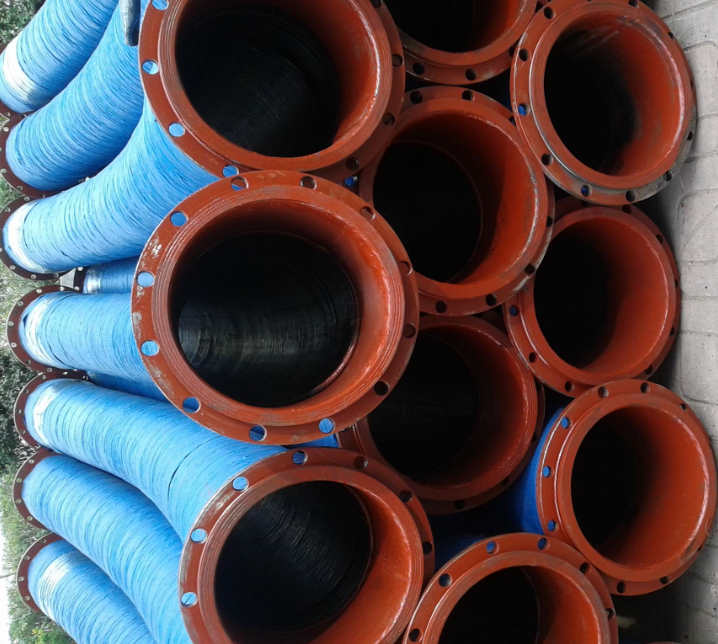
Enable high-pressure fluid conveyance or hydraulic power transmission. Large-diameter high-pressure hose It consists of an inner rubber layer, an intermediate rubber layer, a steel wire braiding layer, and an outer rubber layer. Since large‑diameter high‑pressure hoses do not have a reinforcing carcass, they only require a hose‑pressing operation; clamp‑type hoses necessitate a forming machine that wraps tape around the inner rubber layer; bonded‑inside hoses require specialized equipment; braided and wrapped hoses demand dedicated fabric‑braiding or wrapping machines; and knitted hoses must be produced on a knitting machine.
1. In the coal industry, the primary hydraulic hoses used are those for hydraulic supports. In recent years, pressure requirements for hydraulic supports in some coal mines have increased. Certain wire‑braided hoses can no longer meet these performance demands, necessitating the use of wire‑wrapped hoses instead. Moreover, to mitigate coal dust contamination during mining operations and enhance production safety, various specialized hydraulic hoses are employed in integrated mining processes—for example, coal‑sealing and hole‑expansion hoses, as well as swing‑type hoses used for moisture control in coal seams. According to reports, domestic manufacturers are now producing such products, and they have been tested in over a dozen coal mines as substitutes for comparable imported items.
2. In the 21st century, China’s offshore oil industry strategy emphasizes the focused development of nearshore and shallow-water oilfields. Consequently, in addition to conventional drill‑string tubing and vibrating tubing, the petroleum sector also requires the use of shallow-water subsea pipelines. While shallow-water subsea pipelines are already manufactured domestically, floating or semi‑floating pipelines and deep-water subsea pipelines remain dependent on imports. As China’s offshore oil development strategy is implemented, the performance requirements for subsea pipelines will continue to rise.
3. Types of large‑diameter high‑pressure hoses: Based on their operating pressure, large‑diameter hoses are classified into high‑pressure and low‑pressure varieties. Low‑pressure large‑diameter hoses are further divided into low‑pressure delivery hoses (positive pressure) and low‑pressure suction hoses (negative pressure). The reinforcement layer of high‑pressure large‑diameter hoses is constructed by multiple layers of steel wire braided or wrapped. For low‑pressure large‑diameter hoses, the reinforcement consists of multiple layers of cross‑ply or bias‑ply fabric combined with a helical steel‑wire reinforcement layer. Negative‑pressure suction hoses employ a double‑helix steel‑wire reinforcement structure to ensure that the hose does not collapse or deform under negative pressure.
4. Large‑diameter high‑pressure hoses are categorized as follows: large‑diameter water hoses, large‑diameter mud‑suction hoses, large‑diameter oil‑resistant hoses, large‑diameter acid‑ and alkali‑resistant hoses, large‑diameter high‑temperature hoses, large‑diameter steam hoses, and large‑diameter wear‑resistant hoses. Large‑diameter water hoses are primarily used for conveying or pumping water and other neutral liquids at ambient temperatures, with applications in industrial water intake and drainage, agricultural and forestry irrigation, urban drainage, and river dredging. Large‑diameter oil‑resistant hoses are designed for transporting and pumping fuels such as gasoline, engine oil, lubricating oil, emulsified oil, and cutting fluid. Large‑diameter wear‑resistant rubber hoses are employed for conveying and suctioning solid particulate and powdered media, as well as for transporting cement mortar.
Keywords:
Hot News
Contact Us
Mobile phone/WeChat
Email box
Address
East Zone, Jing County Development Zone, Hengshui City, Hebei Province


Hebei Jiuxing Rubber & Plastic Products Co., Ltd.
East Zone, Jing County Development Zone, Hengshui City, Hebei Province
+86-15631895830(WeChat/WhatsApp)

Scan the code to follow